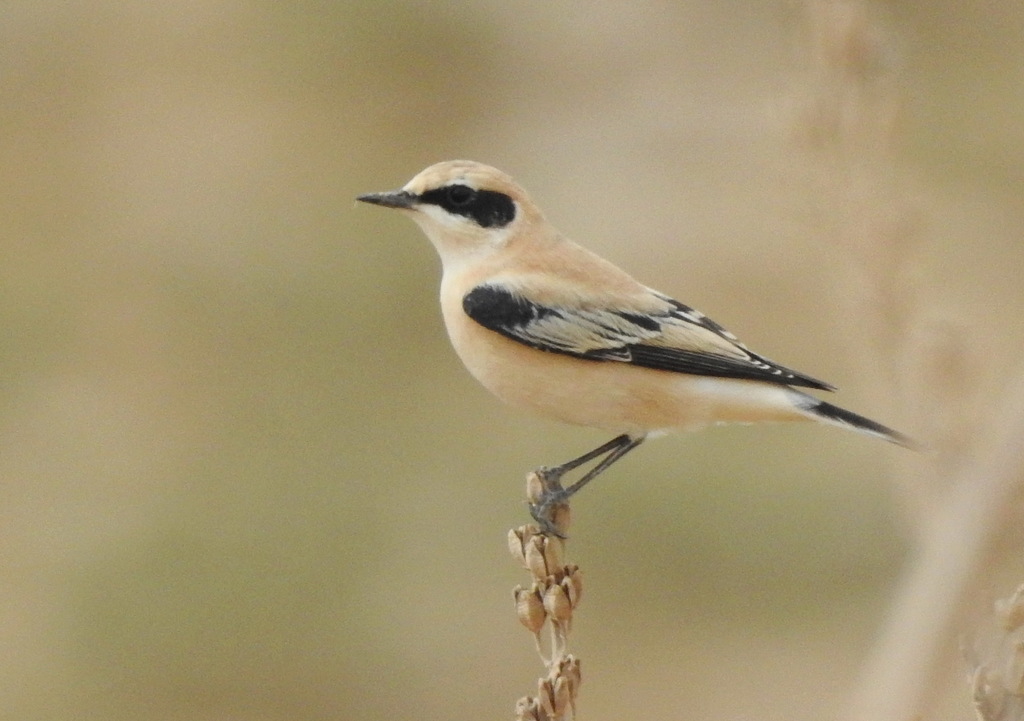
Western Black-eared Wheatear
Photo © Aissa Djamel Filali
Photo © Aissa Djamel Filali — CC BY-SA 4.0 — Source: iNaturalist photo #95172891The western black-eared wheatear (Oenanthe hispanica) is a wheatear, a small migratory passerine bird that was formerly classed as a member of the thrush family Turdidae, but is now considered to be an Old World flycatcher (family Muscicapidae). It was formerly (and still is by some authorities) considered conspecific with the eastern black-eared wheatear. == Description == The breeding male has the forehead and crown white or nearly white, the mantle buff, and the wings blacker than those of the northern wheatear. The underparts are white tinged with buff. The back, upper tail coverts and most of the tail are white. A black mask extends from the ear coverts to the bill. The throat can be either black or white. In autumn and winter the head and mantle are distinctly buff, as are the underparts (including the throat in non-black-throated individuals), but the buff varies in intensity. Except for the central pair, the tail feathers are much whiter than in the northern wheatear, the white on the inner web often extending to the tip. The female is a browner bird, but has the characteristic white lower back, and her seasonal changes are less marked. The male western black-eared wheatear can…
12 Days Birds & Culture Programme in Southern Portugal
12 Days Birds & Wine Programme in Portugal
12 Days in Spain Birdwatching Programme
12 Days Portugal & Spain Birdwatching Programme
Short-break Birds & Conservation Programme in Southern Portugal
Short-break Birdwatching Programme in Southern Portugal
Nothing matches these filters.
Alpilles Regional Nature Park
Alta Murgia National Park
Bardenas Reales
Cabañeros National Park
Cabo de Gata-Níjar Natural Park
Cadí Moixeró Natural Park
Calanques National Park
Camargue Regional Nature Park
Cañón del Río Lobos Natural Park
Nothing matches these filters.
No community photos yet. Log in to add the first one.
No community observations of this species yet.