Egyptian Mongoose
Herpestes ichneumon
Photo © Paulo Martins
Photo © Paulo Martins — CC BY-SA 4.0 — Source: iNaturalist photo #341784754ABOUT
Subspecies of Egyptian Mongoose
Iberian IchneumonCape IchneumonEast African IchneumonMaghreb IchneumonWest African IchneumonMababe IchneumonSangroniz's IchneumonAngolan IchneumonCentral IchneumonEgyptian IchneumonSabie Ichneumon
Identification
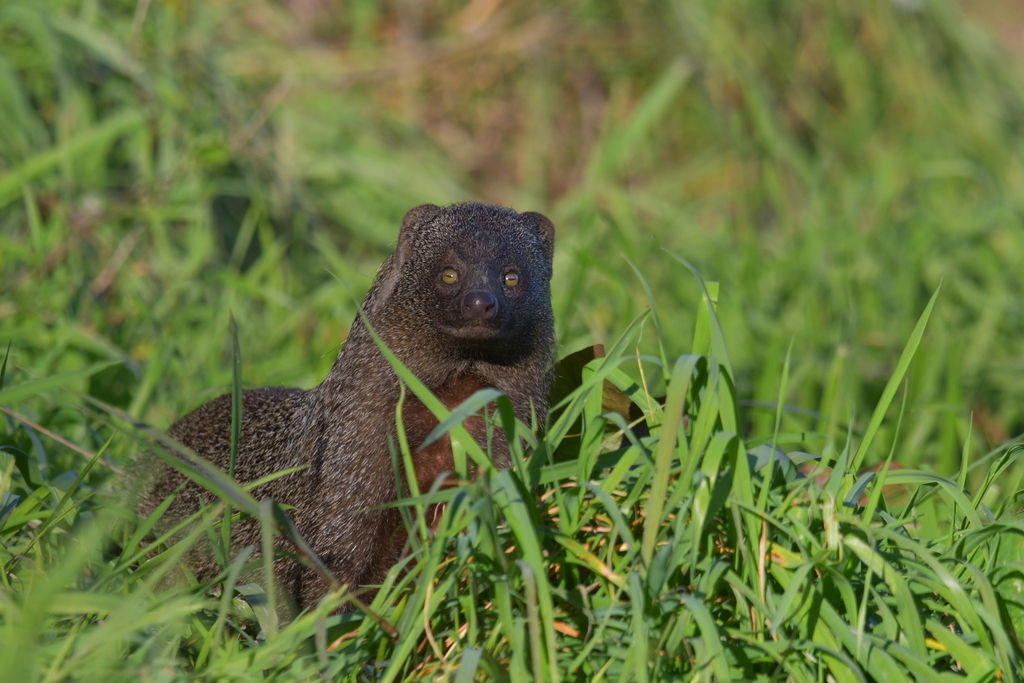
The Egyptian mongoose is a slender carnivore with a pointed snout and characteristically small ears. Its long, coarse fur ranges from grey to reddish brown, densely ticked with brown and yellow flecks that give it a speckled appearance. The body measures 48–60 cm in length, with a distinctive black-tipped tail adding another 33–54 cm. Notably, the hind feet and a small area around the eyes are furless. Adults weigh between 1.7–4 kg, with males generally larger than females. The species possesses 35–40 teeth with highly developed carnassials—specialized teeth adapted for shearing meat—reflecting its carnivorous lifestyle.
Range & Habitat
The Egyptian mongoose inhabits tropical and subtropical grasslands, savannas, and shrublands across Africa, the Mediterranean Basin, the Middle East, and the Iberian Peninsula. It shows a strong preference for wetland environments, occurring in swampy and marshy areas near streams, rivers, lakes, and coastal zones. The species notably avoids deserts. Its range extends from Portugal and Spain through North Africa along the Mediterranean coast and Atlas Mountains, across Egypt and the Sinai Peninsula, into the Levant, southern Turkey, Sudan, Ethiopia, and various regions of West and Central Africa including Senegal, Guinea, Gabon, and Tanzania.
In the Iberian Peninsula, it has been recorded from north of Portugal's Douro River southward and across central Spain to Andalucía and the Strait of Gibraltar, typically in maquis shrubland with dense vegetation near rivers. Its presence in this region may date to Roman times, the medieval Islamic period, or even represent a natural Pleistocene colonisation.
Behaviour & Diet
The Egyptian mongoose is strictly diurnal. It is typically solitary or found in pairs, though groups of up to five individuals have been observed. Adult males are territorial and share their home ranges with one or several females, whose home ranges may overlap except in core breeding areas. The species is an opportunistic carnivore with a remarkably diverse diet. It hunts rodents, fish, birds, reptiles, amphibians, and insects, and also consumes fruit and eggs. To crack open eggs, it employs a distinctive technique of throwing them between its hind legs against rocks or walls.
Prey species documented in its diet include European rabbits, lizards, toads, shrews, skinks, dabbling ducks, egrets, and various rodent species. Notably, this mongoose attacks and feeds on venomous snakes and demonstrates remarkable resistance to the venom of several cobra and viper species, including the Palestine viper and black-necked spitting cobra.
Best Time & Places to See It
The Egyptian mongoose's diurnal habits make daytime observation possible, particularly in wetland habitats near water sources. Protected areas with suitable habitat offer the best viewing opportunities, including Doñana National Park in Spain, Dinder National Park in Sudan, and various national parks across West and Central Africa such as Niokolo-Koba in Senegal and Odzala-Kokoua in the Republic of Congo. The species prefers areas with dense vegetation close to rivers and streams, so searching wetland margins during daylight hours offers the highest likelihood of encounters.
Photography Tips
Photographing this mongoose requires patience and attention to wetland habitats during daylight hours. Early morning and late afternoon often provide the best light for capturing the animal's distinctive speckled fur pattern. The small ears and pointed snout are key identifying features worth emphasizing in photographs. The mongoose's unique egg-cracking behaviour—throwing eggs between its hind legs—presents a rare and dramatic photographic opportunity if you observe this action. Wide shots showing the animal in its preferred streamside or marshy habitat provide valuable context, while close-ups can highlight the texture of its coarse, flecked fur and the characteristic black-tipped tail.
HOTSPOTS
National Park
Monfragüe National Park
Torrejón el Rubio, Spain
+219 birds+10 mammals
Where the Tagus River cuts through limestone plateaus in central Extremadura, Monfragüe National Park rises as a fortress of Mediterranean and Atlantic woodland, its dramatic rocky…
VIEW NATIONAL PARKNational Park
Serengeti National Park
Tanzania
+558 birds+57 mammals
Across Tanzania's northern plateau, where volcanic soils meet acacia woodland and open grassland, unfolds one of Earth's most dynamic ecosystems. The Serengeti National Park sprawls across…
VIEW NATIONAL PARKNational Park
Tablas de Daimiel National Park
Daimiel, Spain
+246 birds+6 mammals
Where the Guadiana River spreads into a labyrinth of shallow lagoons and reed beds across the sun-baked plains of central Spain, Tablas de Daimiel National Park…
VIEW NATIONAL PARKNational Park
Tsavo East National Park
Athi ward, Kenya
+468 birds+50 mammals
Across the semi-arid lowlands of southeastern Kenya, where acacia woodland fragments into scrubland and the landscape rolls toward the Indian Ocean horizon, lies one of Africa's…
VIEW NATIONAL PARKNational Park
Amboseli National Park
Etonet/Lenkism ward, Kenya
+501 birds+43 mammals
Where the Amboseli basin opens toward the Tanzanian frontier, a shallow alkaline lake mirrors vast skies across one of East Africa's most iconic savanna landscapes. The…
VIEW NATIONAL PARKWildlife Management Area
Ngorongoro Conservation Area
Tanzania
+626 birds+55 mammals
Volcanic calderas and open grassland dominate this high plateau in northern Tanzania, where the landscape rises above 2,000 metres and ancient geological forces have shaped both…
VIEW WILDLIFE MANAGEMENT AREA5,0 (1)
National Park
Queen Elizabeth National Park
Uganda
+672 birds+30 mammals
Across the southwestern escarpment of Uganda, where the Western Rift Valley descends through ancient volcanic terrain, Queen Elizabeth National Park sprawls across more than 8,300 square…
VIEW NATIONAL PARKNational Park
Cabañeros National Park
Retuerta del Bullaque, Spain
+183 birds+8 mammals
Cabañeros National Park is one of Spain’s finest wildlife destinations and one of the best-preserved examples of Mediterranean forest and scrubland in Europe. Located in the…
VIEW NATIONAL PARKNational Park
Sierra de las Nieves National Park
Tolox, Spain
+159 birds+7 mammals
Where limestone summits pierce the Mediterranean sky above Andalusia's coastal ranges, Sierra de las Nieves National Park unfolds across nearly 500 square kilometres of dramatically folded…
VIEW NATIONAL PARKNational Park
Garden Route National Park
George, South Africa
+353 birds+54 mammals
Sweeping across the Western Cape's coastal and mountainous terrain, this sprawling national park encompasses over five thousand square kilometers of extraordinarily diverse landscape—from coastal limestone cliffs…
VIEW NATIONAL PARKNatural Park
Sierra de Andújar Natural Park
Our Lady of Cabeza, Spain
+198 birds+19 mammals
Where granite gorges slice through Mediterranean scrubland and cork forests cascade down Andalusian hillsides, one of Spain's most pristine wilderness areas unfolds across 74,000 hectares of…
VIEW NATURAL PARKNatural Park
Montes de Málaga Natural Park
Málaga, Spain
+159 birds+7 mammals
Where cork oak and pine forest sweep across the rugged hills inland from the Costa del Sol, the Montes de Málaga Nature Park unfolds as a…
VIEW NATURAL PARKNatural Park
Estrecho Natural Park
Pedro Valiente, Spain
+281 birds+20 mammals
Where Mediterranean pine forests meet wind-sculpted coastal cliffs, one of Europe's most dynamic ecological crossroads unfolds across the Strait of Gibraltar. Spanning 686 square kilometers of…
VIEW NATURAL PARKCOMMUNITY
Share your photo of this species
No community photos yet. Log in to add the first one.
0
Observed by
0
Hotspots reported
0
Countries
No community observations of this species yet.