Identification
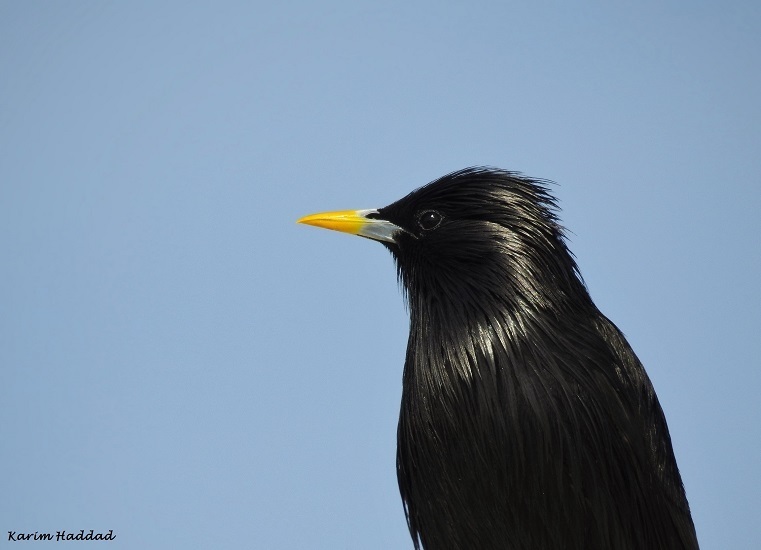
The spotless starling is marginally larger than its close relative, the common starling, measuring 21–23 cm in length and weighing 70–100 g. Adults are distinguished by their darker, oily-looking black plumage with a subtle purple or green gloss visible in bright light. The most striking feature is the bird's conspicuously longer throat feathers, which are roughly twice the length of those on common starlings, forming a prominent shaggy "beard" that becomes especially obvious when the bird is singing. In spring and summer, the plumage appears entirely spotless; in winter, only very small pale spots appear, created by the pale tips of feathers. The legs are bright pink, and the bill is yellow with a bluish base in breeding males or a pinkish base in females, becoming duller and often blackish in winter. Young birds are dull brown with black bills and brown legs, appearing darker than juvenile common starlings.
Distinguishing spotless starlings from common starlings can be challenging, particularly in winter when common starlings are widespread throughout the spotless starling's range, or in summer where their breeding ranges overlap in northeastern Spain and far southwestern France. The longer throat feathers, darker overall appearance, and brighter pink legs are helpful identification markers. The spotless starling can also be confused with the common blackbird, which differs most obviously in its longer tail and lack of plumage gloss. In flight, like common starlings, spotless starlings walk rather than hop, have a strong direct flight, and appear triangular-winged with short tails.
Range & Habitat
The spotless starling is confined to the Iberian Peninsula, northwest Africa, the southernmost regions of France, and the Mediterranean islands of Sicily, Corsica, and Sardinia. The species is largely non-migratory. Notably, its range has expanded significantly in recent decades, spreading to cover the whole of Spain (where it was previously absent from the northeast) between 1950 and 1980, and colonising locally along the southern coast of mainland France since 1983.
This adaptable species uses a wide range of habitats and can be found in any reasonably open environment, from farmland and olive groves to human settlements. The highest population densities occur in open grazed holm oak woods and in urban habitats such as Gibraltar, where the species is common. Like its relative the common starling, the spotless starling is an omnivore, feeding on a wide variety of invertebrates, berries, and human-provided scraps. It is highly gregarious, forming sizeable flocks that often mix with common starlings, sometimes numbering up to 100,000 birds in winter.
Behaviour & Diet
The spotless starling is a noisy, vocal bird and a skilled mimic, with calls that are similar to but louder than those of the common starling. Like most starlings, it is a cavity-nesting species, breeding in tree holes, buildings, and cliff crevices, typically laying three to five eggs per clutch.
As an omnivore, the spotless starling takes advantage of diverse food sources including invertebrates, berries, and opportunistically feeds on human-provided scraps. The species is highly social and gregarious, often seen in substantial flocks that may associate with common starlings, particularly in winter when flocks can reach enormous sizes of up to 100,000 individuals.
Best Time & Places to See It
The spotless starling's largely non-migratory nature means it can be encountered year-round throughout its range. However, winter is an excellent time to observe the species, as birds aggregate into massive flocks of up to 100,000 individuals. Urban habitats such as Gibraltar offer reliable sightings, and open grazed holm oak woodlands support the highest population densities. The species has recently expanded northward into northeastern Spain and along the southern coast of mainland France, making these areas increasingly good for spotless starling observation.
Photography Tips
The spotless starling's dark, glossy plumage requires careful exposure metering to capture the subtle purple and green sheen that becomes visible in bright light—look for conditions with strong, directional sunlight. The bird's distinctive shaggy throat beard is most prominent when singing, so positioning yourself to capture the head raised and throat extended will emphasize this key identification feature. The bright pink legs provide an excellent colour contrast against the dark plumage and should be included in frame when possible. Winter plumage, with its small pale spots, offers a different aesthetic from the spotless breeding plumage. Large winter flocks offer opportunities for behavioural photography, including feeding and perching sequences.