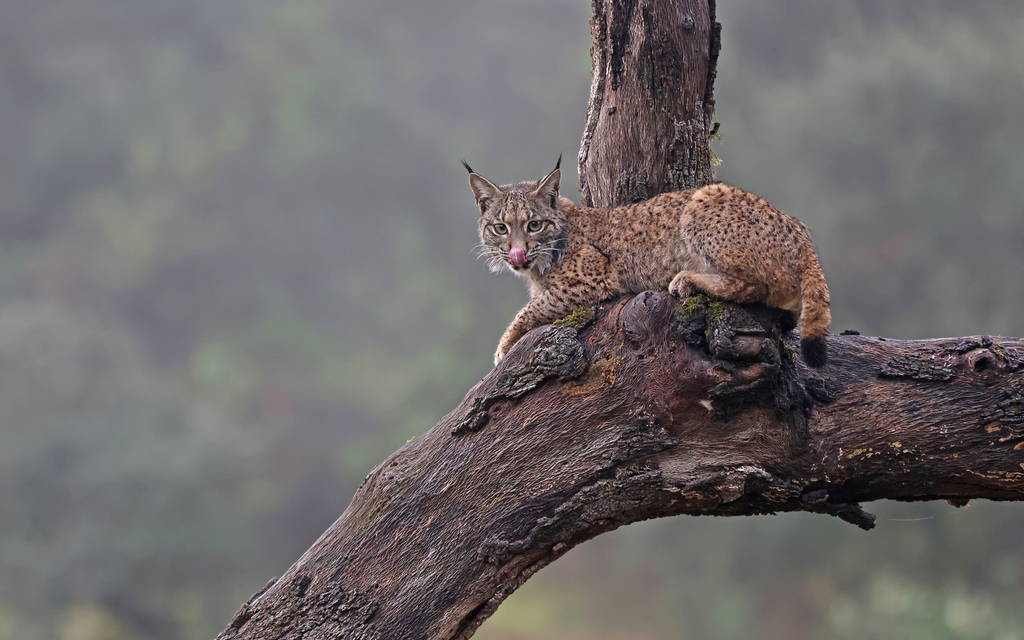
Iberian Lynx
Photo © Christoph Moning
Photo © Christoph Moning — CC BY 4.0 — Source: iNaturalist photo #482334942Identification
The Iberian lynx is a medium-sized wild cat with distinctive spotted fur ranging from bright yellowish to tawny in color. Its spots vary in shape and size—from small and round to elongate—and are arranged in lines that decrease in size from the back toward the sides. Two regional coat-pattern variations exist: Sierra Morena populations display many very small brown to blackish spots, while Doñana individuals show fewer but larger spots arranged in dotted lines.
This compact predator has a small head with characteristically tufted ears and a ruff, combined with a short body, long legs, and a short tail. Males are noticeably larger, measuring 74.7–82 cm in head-and-body length with a 12.5–16 cm tail and weighing 7–15.9 kg, while females are smaller at 68.2–77.5 cm in length and 9.2–10 kg in weight. Extraordinarily rare white individuals have been recorded, with the first photograph documented in October 2025 in Jaén, Spain.
Range & Habitat
The Iberian lynx is endemic to the Iberian Peninsula, though its range has contracted dramatically. Once distributed throughout the peninsula, by the early 1990s it survived in only two isolated subpopulations. Severe habitat fragmentation and prey decline reduced its presence from 15 subpopulations in the 1940s, with populations extending from the Mediterranean to Galicia in the 1950s, to a critical low of just 94 individuals in 2002. The species has since recovered through intensive conservation efforts, with its range now extending across Sierra Morena, Doñana, Montes de Toledo, the Matachel Valley, and areas in Portugal's Guadiana Valley, plus new reintroduction projects in Murcia.
Fossil evidence reveals the lynx inhabited a much wider range during the Late Pleistocene and early Holocene, with remains found as far north as Italy and southern France. Today, as of 2024, the population has expanded to 2,401 individuals, including 2,047 in Spain and 354 in Portugal, with breeding established in previously unoccupied regions including northern and central Extremadura and the Albacete region of Castilla–La Mancha.
Behaviour & Diet
Iberian lynxes are solitary, territorial cats that mark their domains with urine, scratch marks on tree bark, and scat. Adult home ranges are remarkably stable over many years, with females maintaining territories of approximately 5.2–6.6 km² and males occupying larger ranges of 11.8–12.2 km², as documented by camera trapping studies in Sierra Morena between 1999 and 2008.
The species relies overwhelmingly on the European rabbit for survival, which comprises 75 percent of its diet—a specialization that makes it vulnerable to rabbit population crashes caused by myxomatosis and hemorrhagic disease. Supplementary prey includes red-legged partridges, rodents, and occasionally young ungulates such as fallow deer, roe deer, and mouflon, along with waterfowl. A male lynx requires approximately one rabbit daily, while females raising kittens consume three rabbits per day, underscoring the species' dependence on adequate rabbit populations.
Best Time & Places to See It
Sighting Iberian lynxes remains extraordinarily challenging despite population recovery. The best opportunities exist in the core recovery areas of Sierra Morena and Doñana in southern Spain, where conservation efforts are most intensive and populations are most established. The expanding range now includes Montes de Toledo, the Matachel Valley in Extremadura, and Portugal's Guadiana Valley, though lynxes remain elusive and nocturnal.
Year-round presence is possible in established territories, though the lynx's secretive, solitary nature means sightings are rare even in prime habitat. Guided wildlife tours and camera-trap photography opportunities organized through conservation programs in these regions offer the most realistic chance of encountering this iconic Iberian predator.
Photography Tips
Photographing wild Iberian lynxes demands patience, specialized equipment, and often collaboration with conservation researchers. Camera trapping—using motion-triggered wildlife cameras placed in strategic locations within protected reserves—remains the most reliable method for capturing images. Early morning and dusk hours, when lynxes are most active, offer the best natural-light opportunities, though infrared and thermal imaging equipment enables night photography when the cats hunt.
The lynx's spotted coat and distinctive tufted ears are defining photographic features worth highlighting. Wide-angle lenses suit habitat-context shots showing the Mediterranean scrubland and cork oak forests where these cats live, while telephoto lenses (400mm or longer) are essential for distant wildlife photography. Work with local conservation organizations and licensed guides who can access protected recovery areas and provide insights into lynx behavior and movement patterns, significantly improving your chances of documenting this rarely photographed Iberian endemic.
Doñana National Park
Hinojos, Spain
+300 birds+13 mammals
Where the Guadalquivir River delta spreads into the Atlantic, vast marshes, cork woodlands, and coastal dunes converge to create one of southwestern Europe's most biodiverse wetland…
VIEW NATIONAL PARKSierra de Andújar Natural Park
Our Lady of Cabeza, Spain
+198 birds+19 mammals
Where granite gorges slice through Mediterranean scrubland and cork forests cascade down Andalusian hillsides, one of Spain's most pristine wilderness areas unfolds across 74,000 hectares of…
VIEW NATURAL PARKNo community photos yet. Log in to add the first one.
No community observations of this species yet.