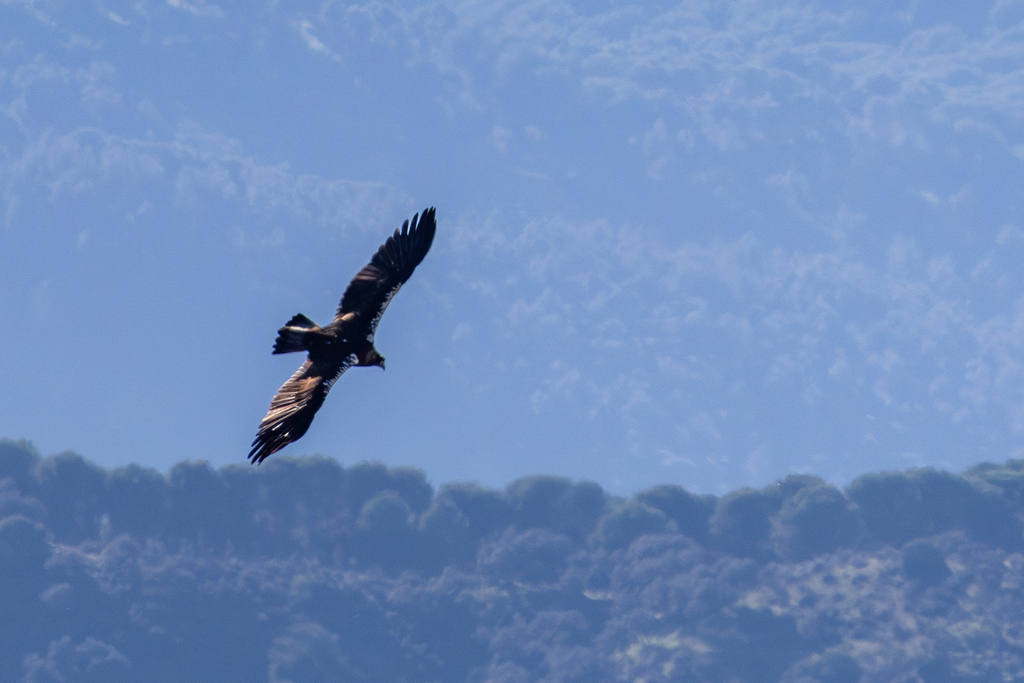
Spanish Imperial Eagle
Photo © Diego González Dopico
Photo © Diego González Dopico — CC BY 4.0 — Source: iNaturalist photo #455675970Identification
The Spanish imperial eagle is a large, powerfully built raptor with a total length of 72 to 85 centimetres and a wingspan of 177 to 220 centimetres. Adults are distinctly darker than their close relatives, displaying a rich blackish-brown plumage extending from throat to belly. The most striking field mark is the pronounced white band across the shoulder and leading edge of the wing—even more prominent than in the closely related eastern imperial eagle—combined with a much paler tawny crown and nape. Females are noticeably larger than males, with wingspans reaching approximately 210 centimetres compared to males' typical 190 centimetres.
Juveniles appear strikingly different from adults, presenting an overall pale straw-sandy colour with broad black bands on the upper and lower wing surfaces. Young birds also display a relatively longer neck and a flatter wing profile in flight, quite unlike the characteristic dihedral (upturned wings) of golden eagles. This distinctive juvenile plumage is a useful identification feature when encountered during dispersal.
Range & Habitat
This species is native exclusively to the Iberian Peninsula, occurring in central and south-west Spain and adjacent areas of Portugal. The bird's stronghold is in the dehesa woodlands of central and south-west Spain, particularly in regions such as Extremadura, Ciudad Real, and the Sierra Norte areas of Huelva and Seville. Unlike its eastern imperial eagle cousin, the Spanish imperial eagle is a resident species, remaining year-round within its range.
The species favours dry, mature woodlands for nesting and seclusion, typically positioning nests close to shrubby openings and wetland areas where prey concentrations are higher. Being naturally shy around humans, these eagles maintain stable home ranges and breed only where human disturbance remains low. Immature birds occasionally disperse beyond the natural range, with vagrants recorded as far as Morocco, Mauritania, Senegal, and exceptionally, the Netherlands.
Behaviour & Diet
Spanish imperial eagles are highly territorial birds that construct substantial stick nests, often in mature cork oaks or pine trees, which can measure 1.5 metres across when first built and expand over time. Breeding occurs from February to April, with pairs typically producing clutches of two to three eggs. Incubation lasts approximately 43 days, and fledging occurs at 63 to 77 days of age, though juveniles may remain dependent for up to 160 days post-fledging. Unfortunately, nestling mortality is primarily caused by human disturbance and nest collapse.
Historically, European rabbits comprised about 58 per cent of the species' diet, but diseases such as myxomatosis and rabbit haemorrhagic disease devastated Iberian rabbit populations. The eagles have adapted by hunting a diverse range of vertebrates, becoming semi-specialized hunters of water birds including coots, ducks, and geese. They also take partridges, pigeons, and crows, with more than 60 bird species documented in their prey spectrum. Mammalian prey includes rodents, hares, foxes, and hedgehogs, while the largest prey items—such as foxes, greylag geese, or white storks—may exceed 3.3 kilograms.
Best Time & Places to See It
The Spanish imperial eagle is a year-round resident of the Iberian Peninsula, making sightings possible throughout the year. The dehesa woodlands of Extremadura, Ciudad Real, and the Sierra Norte regions represent the most reliable locations for encountering this species. The breeding season from February to April may offer increased activity as pairs establish and defend territories, though the birds' naturally shy disposition and preference for low-disturbance areas means patience and discretion are essential.
Immature birds occasionally disperse beyond core ranges, particularly into Portuguese and Moroccan territories during dispersal periods, which may increase the chances of unexpected sightings in peripheral areas. However, dedicated birders should focus efforts on the established strongholds in central and south-west Spain where resident populations are stable.
Photography Tips
Photographing Spanish imperial eagles requires patience, as their shyness around humans and preference for undisturbed habitat means they are often observed from considerable distances. The bird's striking white shoulder patches and darker plumage provide excellent contrast for telephoto photography, particularly in strong sunlight which emphasises these field marks. The pronounced difference between adult and juvenile plumage—with juveniles displaying pale sandy tones and bold wing bands—offers varied photographic opportunities if multiple age classes are encountered.
Soaring birds offer the best opportunities for capturing their impressive wingspan and distinctive silhouette. The paler crown and nape of adults contrasting with blackish-brown body plumage are best rendered in direct or slightly side-lit conditions. Approaching nesting birds should be avoided entirely, as human disturbance is a documented cause of breeding failure. Early morning light often provides optimal conditions for photographing raptors in flight within their preferred woodland and open habitat edges.
Monfragüe National Park
Torrejón el Rubio, Spain
+219 birds+10 mammals
Where the Tagus River cuts through limestone plateaus in central Extremadura, Monfragüe National Park rises as a fortress of Mediterranean and Atlantic woodland, its dramatic rocky…
VIEW NATIONAL PARKCañón del Río Lobos Natural Park
Santa María de las Hoyas, Spain
+136 birds+2 mammals
Where the Río Lobos carves its relentless path through the Iberian plateau, limestone cliffs rise in dramatic ramparts above a ribbon of water that has spent…
VIEW NATURAL PARKSierra Mágina Natural Park
Bélmez de la Moraleda, Spain
+114 birds+2 mammals
Where limestone ridges rise abruptly from the Jaén countryside, Sierra Mágina unfolds as one of Andalusia's most underrated natural treasures. This protected landscape, anchored by the…
VIEW NATURAL PARKDoñana National Park
Hinojos, Spain
+300 birds+13 mammals
Where the Guadalquivir River delta spreads into the Atlantic, vast marshes, cork woodlands, and coastal dunes converge to create one of southwestern Europe's most biodiverse wetland…
VIEW NATIONAL PARKTablas de Daimiel National Park
Daimiel, Spain
+246 birds+6 mammals
Where the Guadiana River spreads into a labyrinth of shallow lagoons and reed beds across the sun-baked plains of central Spain, Tablas de Daimiel National Park…
VIEW NATIONAL PARKCabo de Gata-Níjar Natural Park
San José, Spain
+274 birds+11 mammals
Where volcanic ridges plunge toward the Mediterranean, Cabo de Gata-Níjar Nature Park unfolds across one of Europe's most arid coastlines, a landscape sculpted by tectonic violence…
VIEW NATURAL PARKParque-Reserva Natural de las Quinientas
Berlanga, Spain
+75 birds
Where Mediterranean scrubland rises and falls across the limestone plateaus of central Extremadura, the Parque-Reserva Natural de las Quinientas protects a landscape of profound ecological richness.…
VIEW NATURE RESERVEMontaña Palentina Natural Park
Vidrieros, Spain
+180 birds+29 mammals
Where the Cantabrian mountains rise above the Palencia plateau, Montaña Palentina Nature Park sprawls across nearly 1,500 square kilometres of some of northern Spain's most dramatic…
VIEW NATURAL PARKRedes Natural Park
Arrobio, Spain
+163 birds+16 mammals
Where the Picos de Europa cast their shadow westward, the Redes Nature Park sprawls across nearly 600 square kilometres of Asturian limestone and schist, a wild…
VIEW NATURAL PARKPonga Natural Park
San Juan de Beleño, Spain
+98 birds+13 mammals
Where the Picos de Europa rise in dramatic limestone walls, the landscape softens as you descend into Asturias' Ponga Nature Park, a 407-square-kilometre sanctuary where deciduous…
VIEW NATURAL PARKCabañeros National Park
Retuerta del Bullaque, Spain
+183 birds+8 mammals
Cabañeros National Park is one of Spain’s finest wildlife destinations and one of the best-preserved examples of Mediterranean forest and scrubland in Europe. Located in the…
VIEW NATIONAL PARKSierra de las Nieves National Park
Tolox, Spain
+159 birds+7 mammals
Where limestone summits pierce the Mediterranean sky above Andalusia's coastal ranges, Sierra de las Nieves National Park unfolds across nearly 500 square kilometres of dramatically folded…
VIEW NATIONAL PARKSierra de Guadarrama National Park
Rascafría, Spain
+179 birds+13 mammals
Where granite peaks rise abruptly from the central Spanish plateau, the Sierra de Guadarrama National Park unfolds across more than eleven hundred square kilometres of montane…
VIEW NATIONAL PARKSierra de Cazorla, Segura y las Villas Nature Park
Las Canalejas, Spain
+176 birds+21 mammals
Where granite gorges slice through mountainous terrain in eastern Andalusia, the Sierra de Cazorla, Segura y las Villas Nature Park sprawls across more than 5,200 square…
VIEW NATURAL PARKCadí Moixeró Natural Park
Bor, Spain
+172 birds+21 mammals
Cadí-Moixeró Natural Park is one of the largest and most spectacular protected areas in Catalonia, located in the heart of the eastern Pyrenees. Covering more than…
VIEW NATURAL PARKSierra de Andújar Natural Park
Our Lady of Cabeza, Spain
+198 birds+19 mammals
Where granite gorges slice through Mediterranean scrubland and cork forests cascade down Andalusian hillsides, one of Spain's most pristine wilderness areas unfolds across 74,000 hectares of…
VIEW NATURAL PARKSierra de Gredos Regional Park
Candeleda, Spain
+180 birds+18 mammals
Where granite peaks claw at 2,592 metres and alpine meadows give way to cork oak scrubland, Spain's central highlands reveal a landscape of remarkable vertical drama.…
VIEW NATURE RESERVERegional Park of the Catalan Pyrenees
Olette, France
+244 birds+63 mammals
Where granite peaks thrust skyward above cloud-laden valleys, a wild tapestry of Mediterranean and alpine ecosystems interweaves across the Franco-Spanish frontier. These Pyrenean slopes harbour extraordinary…
VIEW NATURE RESERVEMontes de Málaga Natural Park
Málaga, Spain
+159 birds+7 mammals
Where cork oak and pine forest sweep across the rugged hills inland from the Costa del Sol, the Montes de Málaga Nature Park unfolds as a…
VIEW NATURAL PARKPorts Natural Park
Alfara de Carles, Spain
+157 birds+13 mammals
Where the eastern Catalan ranges descend toward the Mediterranean, a sprawling mosaic of Mediterranean scrubland, pine woodland, and rocky limestone terrain defines Ports Natural Park, a…
VIEW NATURAL PARKSierra y Cañones de Guara Natural Park
Casbas de Huesca/Casbas de Uesca, Spain
+175 birds+10 mammals
Where limestone gorges slice through the pre-Pyrenean foothills of Aragon, the Sierra y Cañones de Guara sprawls across nearly 940 square kilometers of one of Spain's…
VIEW NATURE RESERVESerra de Mariola Natural Park
Bocairent, Spain
+164 birds+19 mammals
Where limestone ridges rise above the Valencian interior, Serra de Mariola unfolds across 225 square kilometers of Mediterranean mountain terrain that shifts between dense evergreen woodland,…
VIEW NATURE RESERVEEstrecho Natural Park
Pedro Valiente, Spain
+281 birds+20 mammals
Where Mediterranean pine forests meet wind-sculpted coastal cliffs, one of Europe's most dynamic ecological crossroads unfolds across the Strait of Gibraltar. Spanning 686 square kilometers of…
VIEW NATURAL PARKSierras Subbéticas Natural Park
Algar, Spain
+156 birds+10 mammals
Where limestone ridges rise abruptly from the Córdoba countryside, the Sierras Subbéticas Nature Park sprawls across nearly 583 square kilometres of one of Andalusia's most rugged…
VIEW NATURAL PARKSierra de Castril Natural Park
Castril, Spain
+110 birds+13 mammals
Where limestone walls rise abruptly from the Guadalentín valley, carving passages of breathtaking drama through Andalusia's interior, one encounters the raw geological theatre of this protected…
VIEW NATURE RESERVESierra de Huétor Natural Park
Huétor Santillán, Spain
+126 birds+3 mammals
Where limestone ridges pierce the Mediterranean sky above Granada, a 273-square-kilometre sanctuary of pine forest and alpine meadow rises to nearly 2,400 metres. This protected landscape,…
VIEW NATURAL PARKSierra de Boumort
Segan, Spain
+145 birds+13 mammals
Where granite gorges slice through the Catalan Pyrenees, ancient limestone cliffs rise in dramatic ramparts above dense Mediterranean forests. This wild corner of northeastern Spain harbors…
VIEW MOUNTAIN & ALPINEColl de Pal
La Molina, Spain
+142 birds+12 mammals
Where the eastern Pyrenees descend into Catalonia, alpine meadows and rocky slopes define the character of this mountain pass, a threshold between the high Iberian interior…
VIEW MOUNTAIN & ALPINEPyrénées National Park
Hautes Pyrenees, France
+150 birds+35 mammals
Where alpine meadows give way to limestone cliffs and rushing torrents carve through ancient stone, the Pyrénées National Park spans a landscape of austere beauty along…
VIEW NATIONAL PARKNo community photos yet. Log in to add the first one.
No community observations of this species yet.